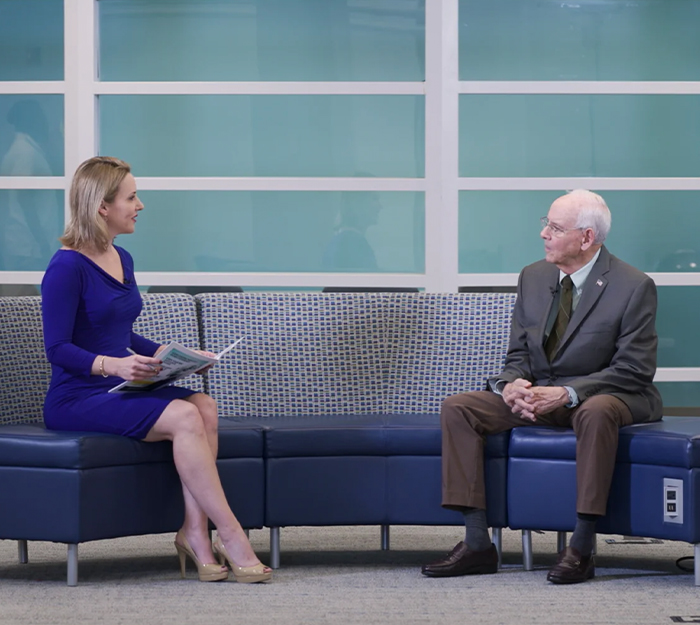
Interviewer: As a former president of RBC, tell us about your dissertation on the history of the school.
Dr. McNair: Well, when I first came to Richard Bland in 1968, it was my idea that I needed to find out a little bit about how this college got started, who was responsible for it, and what the political forces behind it were. There was Colonel Daniel Davis from the Air Force, Captain Sullenberger from the Navy, and Captain Young from the Army.
By 1979, when I was working on the dissertation, I said this is going to be a great topic for me to pursue. You can imagine that I thought I had really come to a military organization, but I think I was fascinated by the fact that this very property was [a farm] prior to the Civil War.
During the Civil War, there were two major battles fought here on the grounds: Globe Tavern and the Weldon Railroad. The Weldon Railroad [unclear] held by the Union during the siege. This was Union-occupied property during that particular time. Part of the Weldon Railroad is located on the other side of [Ernesto/unclear].
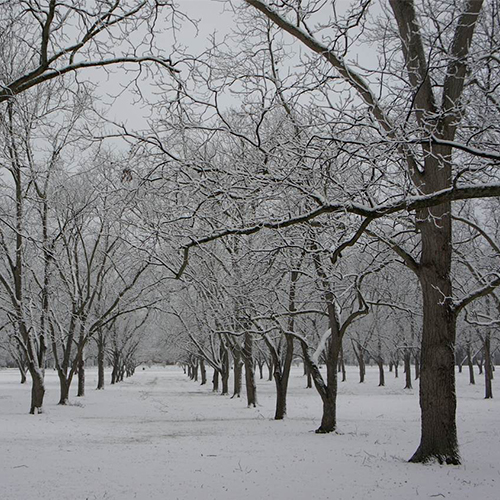
Later on, it became a dairy farm. That’s when the houses and the pecan groves were built.
Then later on, it became part of Central State Hospital for handicapped African American students.
Then it closed in ’59, and I said that is quite a history. So I began to delve into that and looked to see what the political factors affecting it were. That was really the title of my dissertation — the political factors and the interplay between Hopewell, Petersburg, Colonial Heights, and the surrounding counties: Prince George, Dinwiddie, and Chesterfield. As a result of that, I saw the beginnings of the college and began to write about it.
Interviewer: You recently visited RBC and gave a talk about the school’s history. What was that experience like, talking about the school’s past with students of today?
Dr. McNair: Well, I think most of them had never heard of some of the early beginnings of the college. This all began in Hopewell. In fact, there was a college in Hopewell that preceded Richard Bland.
They were successful in using space in old Hopewell High School at night. In the first year, in 1959, Hopewell College had 175 students.
That college in Hopewell lasted only for about five years because it had no property, no accreditation, and only adjunct faculty. It was only being taught at night in the old Hopewell High School and had no real financial support.
As a result of that, people in Petersburg — particularly W. Roy Smith and Frank Ernst, who was the president of Allied Chemical, although he lived in Petersburg and worked in Hopewell — began to push for a college in this area. That’s how Richard Bland really got started during that era, 1959–1960.
Interviewer: Thank you, Dr. McNair, for talking with us on Inside RBC TV.
Dr. McNair: Well, thank you so much for the opportunity to be here.
Captions:
WEBVTT
1
00:00:00.300 --> 00:00:03.200
As a former president of RBC tell us about your
2
00:00:03.200 --> 00:00:06.400
dissertation on the history of the school. Well, when I
3
00:00:06.400 --> 00:00:09.100
first came to Richard Bland in 1968, it was
4
00:00:09.100 --> 00:00:12.500
my idea that I needed to find out a little bit about how
5
00:00:12.500 --> 00:00:15.300
this colleague got started and who was responsible for
6
00:00:15.300 --> 00:00:18.200
it. And what were the political forces behind it.
7
00:00:18.200 --> 00:00:21.400
There was Colonel Daniel Colonel Davis from the Air Force
8
00:00:21.400 --> 00:00:25.000
captain sullenberger from the Navy and Captain
9
00:00:24.300 --> 00:00:26.000
Young from the Army.
10
00:00:26.700 --> 00:00:29.000
And then By 1979 when I was
11
00:00:29.600 --> 00:00:32.700
working on the dissertation that we've been married I said
12
00:00:32.700 --> 00:00:35.500
this is going to be a great topic for me to pursue you
13
00:00:35.500 --> 00:00:38.100
can imagine that. I thought I had really come to a military.
14
00:00:39.300 --> 00:00:42.500
Organization, but I think I was fascinated by
15
00:00:42.500 --> 00:00:47.000
the fact that this very property was foreign
16
00:00:45.100 --> 00:00:47.900
prior to the Civil War.
17
00:00:49.400 --> 00:00:52.300
That during the Civil War there were two major battles fought here
18
00:00:52.300 --> 00:00:55.500
on the grounds Globe Tavern and the welding railroad.
19
00:00:55.500 --> 00:00:59.200
Well in railroad Supply lease proofs held
20
00:00:58.200 --> 00:01:02.300
by the union during the season. This
21
00:01:01.300 --> 00:01:04.800
was Union occupied property during
22
00:01:04.800 --> 00:01:07.600
that particular time part of the welding railroad
23
00:01:07.600 --> 00:01:09.900
is located on the other side of Ernesto.
24
00:01:10.500 --> 00:01:13.600
And then later on it became a dairy farm. That's when
25
00:01:13.600 --> 00:01:15.600
the houses and the pecan grows were built.
26
00:01:22.100 --> 00:01:25.400
And then later on it became part of Central State to
27
00:01:25.400 --> 00:01:28.900
hospital for handicapped African-American students.
28
00:01:35.900 --> 00:01:38.200
And then it closed in 59 and I said
29
00:01:38.200 --> 00:01:41.500
that is quite a history. So I began to delve into
30
00:01:41.500 --> 00:01:44.500
that and and looked at see what were the
31
00:01:44.500 --> 00:01:47.300
political factors affecting and that was really the title of my
32
00:01:47.300 --> 00:01:51.700
dissertation was the political factors that the interplay
33
00:01:50.700 --> 00:01:53.900
between Hopewell Petersburg Colonial
34
00:01:53.900 --> 00:01:56.400
Heights in the county surrounding counties Prince
35
00:01:56.400 --> 00:01:59.800
George's dinwiddy and Chesterfield and as a
36
00:01:59.800 --> 00:02:02.400
result of that I saw the beginnings of the college and
37
00:02:02.400 --> 00:02:03.400
began to write about it.
38
00:02:21.700 --> 00:02:24.200
You recently visited RBC and gave
39
00:02:24.200 --> 00:02:27.400
a talk about the school's history. What was that experience
40
00:02:27.400 --> 00:02:30.400
like talking about the school's past with students
41
00:02:30.400 --> 00:02:33.400
of today? Well, I think it most of
42
00:02:33.400 --> 00:02:36.300
had never heard of some of the early beginnings of
43
00:02:36.300 --> 00:02:36.900
the college.
44
00:02:38.400 --> 00:02:41.700
6 this all began in Hopewell.
45
00:02:41.700 --> 00:02:44.400
And in fact that there was a a college
46
00:02:44.400 --> 00:02:47.700
in Hopewell that preceded Richard
47
00:02:47.700 --> 00:02:48.300
Bland.
48
00:02:48.900 --> 00:02:52.000
And they were successful in using space
49
00:02:51.700 --> 00:02:54.400
in hopeful. How old Hopewell High
50
00:02:54.400 --> 00:02:55.500
School at night.
51
00:02:56.300 --> 00:03:01.900
And the first year in 1959 Hopewell
52
00:02:59.900 --> 00:03:02.300
College had
53
00:03:02.300 --> 00:03:03.500
175 students.
54
00:03:04.400 --> 00:03:08.100
And that College in Hopewell lasted only
55
00:03:07.100 --> 00:03:11.000
for about five years because it had
56
00:03:10.200 --> 00:03:14.500
no property that had no accreditation. It
57
00:03:13.500 --> 00:03:16.000
had only adjunct faculty. He was
58
00:03:16.400 --> 00:03:19.600
only being taught at night in in the Old Hopewell High
59
00:03:19.600 --> 00:03:22.900
School and had no really financial support.
60
00:03:27.700 --> 00:03:30.900
As a result of that people in Petersburg, particularly W
61
00:03:30.900 --> 00:03:33.600
Roy Smith and Frank Ernst
62
00:03:33.600 --> 00:03:36.500
who was the president of Allied chemical although he
63
00:03:36.500 --> 00:03:39.700
lived in Petersburg. Although he worked in Hopewell. He
64
00:03:39.700 --> 00:03:42.400
began to push for a college in
65
00:03:42.400 --> 00:03:45.200
this in this area and that's how Richard Bland really got
66
00:03:45.200 --> 00:03:48.300
started during that era 1959 1960.
67
00:03:48.900 --> 00:03:51.500
Thank you, Dr. McNair for talking with us on inside
68
00:03:51.500 --> 00:03:54.500
RBC TV. Well, thank you so much for the opportunity
69
00:03:54.500 --> 00:03:55.100
to be here.
HISTORY OF RBC
POLITICAL FACTORS AFFECTING THE ESTABLISHMENT AND GROWTH OF RICHARD BLAND COLLEGE IN VIRGINIA 1958-1972 by DR. JAMES B. MCNEER
The need for a two-year college in Southside Virginia was enhanced by the interest of and support generated by The College of William and Mary. Even though William and Mary was not the first four-year institution approached by interested citizens in the Petersburg area, it was the one that agreed to support a local branch college. The establishment of Richard Bland by William and Mary would serve as a base for William and Mary exerting an influence on the direction of higher education in Virginia, reaching from south of Richmond to the North Carolina line and east to the Atlantic Seaboard. This political goal of William and Mary coincided with the desire of certain citizens in the Petersburg area to make available to high school graduates an inexpensive, state-supported, commuter institution near their homes. Only Virginia State College, a four-year, black, state-supported institution existed in Southside Virginia at the time of the creation of Richard Bland College.
Born of Innovation 1960
Richard Bland College (RBC), Virginia’s selective, two-year, residential, liberal arts transfer institution, was born through innovation. In 1959, years before the Virginia Community College system was imagined, Frank Ernst – a Gateway region native, entrepreneur, and retired executive of Hopewell’s Allied Chemical Plant – proposed the creation of an institution grounded in the liberal arts tradition with opportunities for specialized training in in-demand fields such as engineering to the State Council of Higher Education. After discussions with Virginia Tech and the University of Virginia, Ernst found a willing partner in the College of William & Mary, the second-oldest university in the United States, who founded Richard Bland College in 1960. RBC has since offered multiple certificates and university-parallel two-year degrees.
By attending Richard Bland College and earning an Associate Degree, you will have completed the first two years toward the Baccalaureate Degree.
Richard Bland College has guaranteed transfer agreements with four-year colleges and universities across the Commonwealth that will enhance your educational opportunities. The Board of Visitors of William & Mary has authorized Richard Bland College to confer Associate degrees designed for transfer to four-year institutions in Virginia and throughout the United States.
Four-Year Transfer Partners
Richard Bland College prepares students for transfer to highly-ranked colleges and universities. RBC has guaranteed transfer agreements with 35-plus institutions throughout Virginia that enables you to seamlessly transfer to earn your bachelors degree.
We use cookies to analyze traffic and improve your experience. By continuing without changing your cookie settings, you agree to this convention. For more information, please see our Privacy & Security Statement.